Feature: Schrijfhulp
Schrijfhulp is the AI assisted writing feature of Attendi. It helps healthcare professionals create clear, well-structured reports based on spoken input. Schrijfhulp streamlines documentation while always keeping the professional fully in control of the final content.
Schrijfhulp is designed to be used in combination with live speech-based reporting, where audio is converted into text in real time via WebSockets. This live transcription forms the input on which Schrijfhulp generates improved, structured reports.
You can read more about Schrijfhulp here.
Use of Generative AI (LLM technology)
Schrijfhulp is powered by generative Large Language Model (LLM) technology. This type of AI analyzes spoken or written input and generates new text based on patterns in language. In practice, this means Schrijfhulp can:
- Improve sentence structure, clarity and readability
- Apply professional reporting formats
- Summarize input
While this technology is very powerful, it is not infallible. AI generated text may occasionally contain inaccuracies, missing context, or unintended interpretations. Therefore, it is essential that a healthcare professional always reviews and validates the generated text before saving it.
For this reason:
- Reports created with Schrijfhulp are never saved automatically into the EHR system.
- The healthcare professional remains fully responsible for the final content at all times.
UX Recommendation for Software Partners
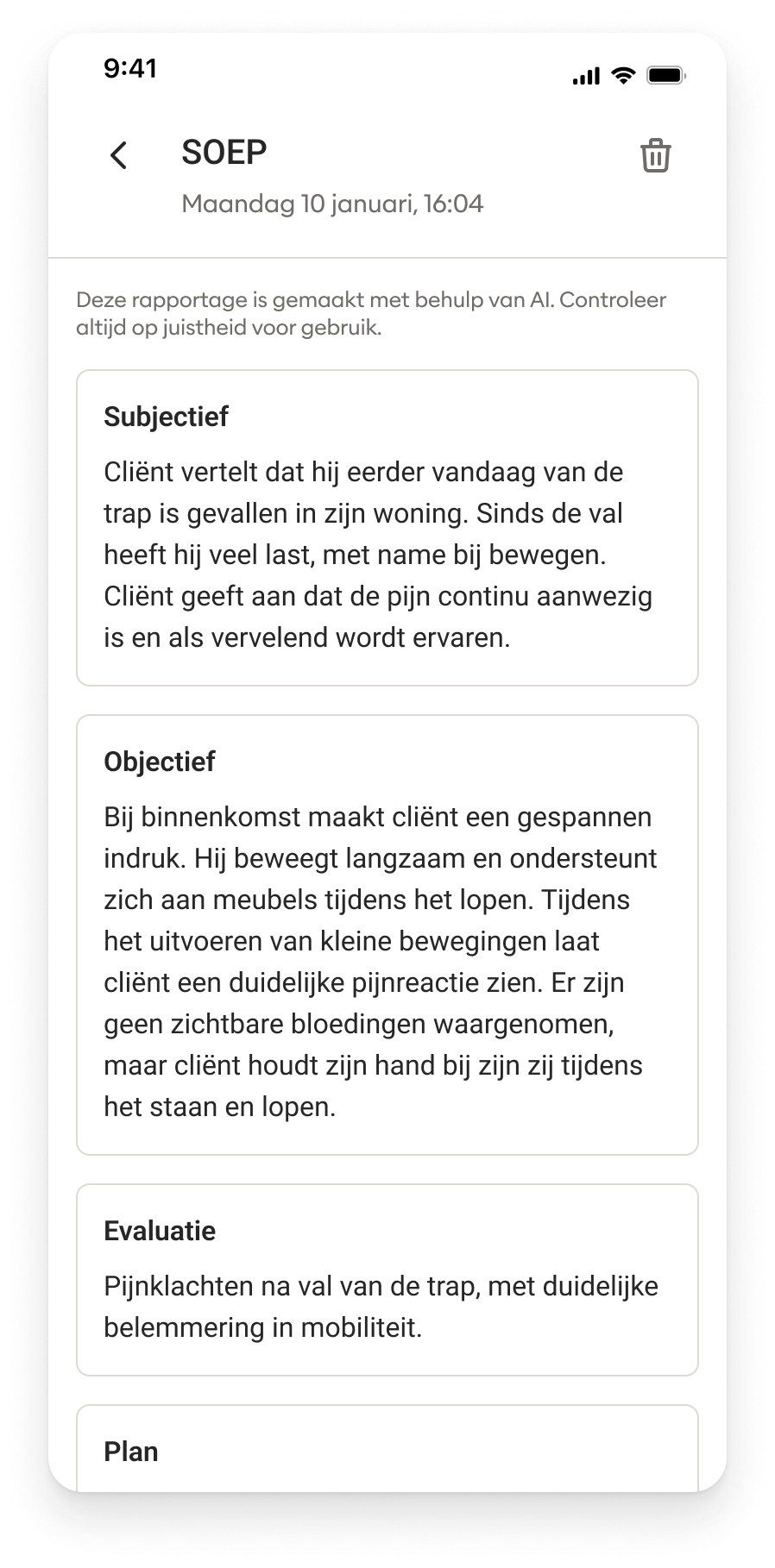
When implementing Schrijfhulp, we strongly recommend that users are clearly informed that AI is being used to generate the report. This can be done, for example, by showing a visible banner above or below the text field stating that:
- The text was generated with AI assistance
- The user remains responsible for checking the content
A visible banner above or below the text field reminds users that AI is being used and that they remain responsible for checking the content before saving.
Quality Monitoring & Model Improvement
At Attendi, we continuously monitor the performance of Schrijfhulp to ensure safe and reliable use in the healthcare process. We evaluate three key quality dimensions:
- Faithfulness – Does the generated text stay aligned with what was actually spoken?
- Structure – Does the report follow the required layout and format?
- Clarity – Is the text clear, readable, and easy to understand?
By combining these metrics with customer feedback, we can detect issues early and continuously improve the models in a targeted and controlled way.
Voice Commands
Schrijfhulp supports several voice commands that allow users to instantly transform their spoken input. Below is an overview of the available commands and what they do:
-
SOEP Converts the text into a report structured using the SOEP method (Subjective, Objective, Evaluation, Plan).
-
SOAP Converts the text into a report structured using the SOAP method (Subjective, Objective, Assessment, Plan).
-
TIME Structures the report according to the TIME model for wound care documentation.
-
"Write a letter" Converts the spoken input into a formal letter format, for example for communication with a GP or specialist.
-
"Summarize" Creates a concise summary of the spoken or written input.
-
"Create a list" Converts the spoken input into a formatted list or enumeration.
-
"Improve the report" Improves clarity, grammar, and professional language while keeping the original meaning intact.
These commands enable healthcare professionals to quickly transform raw speech into high quality documentation with minimal manual editing.
Development & Background
The development of Schrijfhulp was driven by real-world needs of healthcare professionals: reducing administrative burden, speeding up documentation, and improving the readability and consistency of healthcare reports. The solution is built on advanced LLM technology combined with real-time speech-to-text conversion, carefully tuned to the workflows of healthcare professionals.
Our development process and design decisions — from initial concept to model fine-tuning and integration — are described in detail in this article.
In this article you can read about:
- The motivation behind Schrijfhulp
- Technical challenges we overcame
- How the system was evaluated and tested before release